$10 Laptop

Perak is smouldering!I knew that it was too good to be true and it turns out that it was. There were lots of conflicting reports on an Indian $10 laptop. Turns out that the device is not a laptop but rather a storage device. So, instead of replacing the textbooks in class, they are going to replace school bags.

It is basically a over-glorified flash drive with a bluetooth connection. While this device would have had a great market about 7 years ago, this is not so big today. Storage prices are dirt cheap. You can get a 4Gb flash drive for under $10 and 4Gb can store a whole lot of text books and other reference materials.

However, I do like one the basic concept – which is to remove the whole idea of school bags entirely. A kid just needs to bring a thumbdrive to school, loaded with reference materials (including an entire encyclopedia). The kid can plug this into the school terminal and use it for lessons. Teachers can assign homework (on PDF forms) that students carry home and do it on their home computers. They then carry it back to school the next day to be evaluated by software. Snazzy!

We can already implement this today with USB thumb-drives. For RM26 ($7) retail, we can already buy a 4Gb thumbdrive. Anyone who grew up in the 90s like me, will remember using multi-media encyclopedias that fit on a single CD-ROM (700Mb). With newer compression technology, we can definitely fit even more information on this 4Gb drive. 4Gb is a lot of storage space.

All that is needed then, is a way to use the storage space effectively. Students would need to be provided with individual computer terminals in school. This may turn out to be cheaper than trying to give every child an individual laptop. Centralised terminals are much easier to deploy and maintain than individual computers. All we need is a system like the LTSP system.

Wow, this is most definitely do-able. Unfortunately, I’m not interested in it.

Silver Sandiwara

I don’t think that anyone really knows what is happening in Perak. Personally, I don’t even want to know. I just hope that the Sultan/Regent will make the right decision and leave such decisions to the people. Although I have been down for the last few days, I have been following events as best I could.

However, I would like to quote our opposition leader, Anwar Ibrahim:

BN is trying to form the state government by hook or by crook – more by crook.

He says the funniest things sometimes. I assume that he is saying this in respect to the froggie state reps who have jumped ship to the BN. Funny thing is that he croons a totally different tune when someone decides to defect over from BN to the PR side. I guess that it is just another day at the office for these politicians. Just remind me never to turn into one.

E-Machines EL1700

what is najib smoking?E-Machines is not a brand name that is well known in Malaysia. After being bought by Gateway (which was subsequently bought by Acer) several years ago, they seem to have languished and been forgotten but I have recently spotted a unit at a local computer store. The EL1700 is destined to be a HTPC machine.

At a glance, it has:

  • Intel E2200@2.2GHz processor
  • 1GB RAM
  • GeForce 7100 graphics
  • nForce 630i chipset
  • VGA and HDMI video outputs
  • 5 Audio ports and S/PDIF audio outputs
  • Multiple memory card readers

Its VGA and HDMI ports mean that it can be connected to any LCD-TV unit with ease. The 5.1 and S/PDIF audio outputs enable it to output sound to any low or high end sound system. The integrated memory card reader allows photos from digital cameras to be viewed. Most importantly, it has a built in PCI/E port for adding a suitable TV capture card.

Wow!

My main concern is power. I’m pretty sure that the ‘active’ power usage will be higher than an Atom based system. However, ‘passive’ power usage should not be too bad. I will definitely hibernate the machine when it is not in use, which will be most of the time. Until I actually measure the power consumption using a DMM, I won’t trust any power consumption numbers released by the manufacturers.

PS: It does not look half bad either. You can even lie it down flat.

Neighbourhood Networks

In a recent blog entry on Education Malaysia, Ong Kian Ming mentioned setting up a neighbourhood network (NN) so that kids would be able to play multi-player computer games at home and they would not need to hike off to the seedy cyber-cafes (CC) for their regular fix of group fun. However, it dawned on me that this NN is an excellent idea.

Disclaimer
The kind of network that I am describing can be seen as a form of wireless mesh network. Incidentally, the OMRP, which is an open hardware/software platform for implementing wireless mesh networks, uses my aeMB processor at its core. However, none of what I have to say, is processor dependent.

Installation
It is extremely easy to set up a NN today. Gone were the days when cables had to be lain from point to point. Today, we can just do the entire thing with WiFi. If every family buys a wireless router and sets up a home zone, all these zones can be combined together to form a blanket network. This can be achieved using something called the Wireless Distribution System (WDS), which is present on almost all modern routers.

Applications
There are some very obvious applications with the NN.

It would now be fantastically free to call up your neighbours on voice-over-IP (VoIP) technology. There is no need to use any phones to ring up your neighbour. Furthermore, you don’t need to limit yourself to just streaming voice, but you can also stream video over the network. So, it would be easier than ever to bug your neighbours. Of course, there are many other more creative pursuits that one can pursue using this technology.

With a network communications infrastructure in place, it would be trivial to install various IP-security devices. There is a lot of interesting work being done in the field of sensor networks, which generally employ a large number of simplistic sensor devices to produce all kinds of telemetry data that can be analysed for any number of applications. This brings the neighbourhood watch to a whole new level.

Issues
There are some legal issues to deal with, especially if the NN shares multiple Internet connections. The NN can combine and aggregate these multiple connections into a single large pipe. However, ISPs often have legal restrictions in place on the freedoms of end-users to ‘share’ their connections. Obviously, if a resident does something illegal on-line, it creates a whole host of legal issues as well.

Anyway, this sounds like a great idea to me. Maybe, instead of rolling out a state-wide WiFi infrastructure, our local governments should actually focus their resources at setting up and linking a number of neighbourhood networks. The people can help fund the project by supplying part of the equipment while the government takes care of the pipes linking the disparate networks and the Internet.

Windows 7 BSoD

Hell must have frozen over! Pigs must be flying in the sky! The dead must be walking in the streets! Chaos! Mayhem! Anarchy! Windows 7!

While I would normally not touch anything MS without a 10 yard pole, I’ve been hearing a lot of good things about Windows 7. Then today, a friend of mine who works for Microsoft (and shall remain nameless) asked me if I’d like to give Windows 7 a try. Being naturally curious about things like this, I thought that I’d give it a go to see what the fuss is all about.

Since I did not have any machine that met the minimum requirements for Windows 7 except for my main machine, I decided to install it inside a virtual machine instead. I ran a VM with 1Gb of RAM and 16Gb of hard disk space as the minimum requirements suggested. The installation took a very long time to finish but in the end, it only consumed about 6Gb of disk space.

My host machine is a dual-core AMD64 processor with 2Gb of memory. To make things run fast, I enabled hardware based virtualisation, which uses the VT extensions of the AMD processor to run things faster. What this means in layman terms is that I made the VM run as fast as I could, without purposely trying to degrade its performance in any way. During the install process, I took many screen shots of the virtual screen.

While I have yet to actually play with it fully, I think that it is safe to say that there are already visible pros and cons with the new OS. The main pro is that it does seem to boot fairly quickly and the interface feels responsive. The main con is that the user unfriendly-ness of Vista is still evident. As for the new look and feel of the OS, that is a very subjective thing to measure.

One thing that I do not understand about Windows is its inherent affinity towards rebooting the computer. During the installation process, it rebooted the VM several times. When it installed updates, it rebooted the VM again. Seriously, MS should think of a way to do these things without the unnecessary reboot. As other OSes have shown, it is perfectly possibly to do things without rebooting all the time.

It is good for me to know that Windows 7 will run on a lowly 2D graphics processor, which is what the VM emulates. Actually, with the VM, I was able test that it will happily boot up with only 128Mb of memory, although it uses a lot of disk space as swap and trashes the performance greatly. With only 64Mb, the dreaded ‘blue screen of death’ makes an appearance. It is good to see that some things do not change.

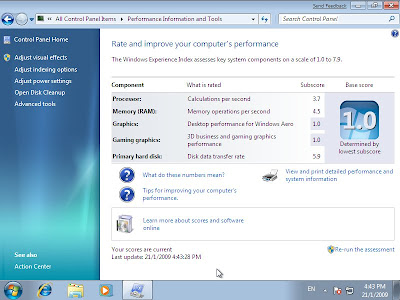
Okay, enough griping. Here are the screen shots.

http://picasaweb.google.com/s/c/bin/slideshow.swf

Auguring Obama

inaug4I watched Obama’s inauguration ceremony LIVE last night, on CNN and BBC. There were a number of video sites that were streaming the show including the likes of Hulu and Joost. However, I chose these sites because they were smoother than the rest. CNN only began to break up halfway through his speech, forcing many people to switch over to the Beebs.

What surprised me most was that I could actually watch the whole ceremony live on my meager Slowmyx connection. Anyone who knows our local broadband provider knows that their connection rates are highly unpredictable and typically much slower than advertised. Considering that I subscribe to a 512k connection and the videos were streaming in at 512k, I was quite impressed.

As for the actual ceremony itself, it was quite interesting as I had never seen a presidential inauguration before. It was funny when Obama had some problems with his oath taking bit and that it caught the justice by surprise as well. I guess that someone must have been extra nervous. I also liked the speech that he gave, trying to bring people together for the coming battle.

This got me thinking about my HTPC again. If 512k is enough to stream a live news feed, I might actually double that to a 1M line when I have my HTPC up, just so that I can watch online TV and not bother about installing Astro at home. I personally feel that Astro is a money sucking pit with terrible service. It has not seen an upgrade in service level quality since its early days. Just like almost everything else in Malaysia, Astro is a frakkin’ monopoly.

Therefore, it has had no incentive to upgrade it’s services. For one, it has definitely got the technological capability to bring in some wide-screen HD channels. There is even a growing market for such a service with new televisions being sold as wide-screen HD capable systems. There is even a menu entry for 16:9 in its settings, which incidentally does nothing. Seriously, besides carrying more “on-demand” SD channels, there seems to have been little change to its service.

Enough of my rant. I don’t have Astro at home anyway. So, setting up an IP-TV (so to speak) at home should be part of the HTPC functionality. Now, the only problem would be actually finding channels that would stream content to Malaysia. However, that is a problem that I can easily remedy. So there, I now have another reason to set up a HTPC in my living room.

LCD-TV Madness

Well, I found an unsolicited print advert in my post box today (otherwise known as spam), and it was from a local electrical appliance chain store. Right on the front page was a promotion for a “Super Branded LCD TV” for only RM1499 (£290)! Although it does not reveal the brand, it says there that it has “smart networking with VIERA link”, which was a dead giveaway.


Looking at the local Panasonic website, this “Super Branded LCD TV” is the Panasonic VIERA TX-32LE8MK, the lowest end LCD-TV that they carry in Malaysia. It is likely that this particular model is being EOL-ed and Panasonic is trying to get rid of them. Still, RM1499 is a very decent price for a brand name product. It has all the necessary bells and whistles one would expect from a 32″ LCD-TV.


As for the wireless keyboard that I had mentioned the other day, the LuxMate 810 Media Cruiser, it seems that this particular model has already been tested and certified to work out of the box (without any driver installation) on a Ubuntu system. So, it should work perfectly well with MythBuntu as a full fledged keyboard and mouse combo for only RM99.


As for the actual HTPC system, instead of buying the Compaq mini-Q NetTop, I might just assemble one myself. I’ve found a local retailer for a mini-itx chasis which looks okay, as a HTPC chasis for only RM200. Bundle that with a D945GCLF2 (RM290), 1Gb RAM (RM50) and 4Gb Flash (RM30), we’ve got a working HTPC system. I could add a USB Wifi for about RM50.

The final price tag would only be about RM2200! Not too shabby, really.