Bad Computer Science Programmes

This article first appeared in DNA.

I sent drafts of my previous article to the Deans of several local Computer Science (CS) faculties for comment. One expressed reservation in labelling it bad CS programmes as they are all accredited by the Malaysian Qualifications Agency (MQA). Therefore, none of them are bad per se.

I would have to humbly disagree.

But first, I browsed through several documents – the Malaysian Qualifications Framework (MQF)i, Code of Practice for Institutional Audit (COPIA)ii, Code of Practice for Programme Accreditation(COPPA)iii and the Programme Standards for Computing (PSC)iv, to gain an insight into how programmes are accredited.

Briefly, the MQF provides the structural classification for all academic programmes in Malaysia such as the levels of qualifications from Certificate to Doctoral levels, with their associated learning outcomes, credit system and other criteria.

When the Code of Practice documents are read together, they constitute a check-list of items that must be furnished and questions that must be answered when preparing accreditation documents. They include standard forms that need to be submitted with guidelines for completing them.

The PSC specifies details for each course to fulfill these requirements. Among other things, it also suggests credit hours allocated to various compulsory, core and elective modules; and also lists down the core knowledge areas to be covered by the syllabus.

Taken together, these documents form a complete template for running quality academic programmes, except for one minor detail.

In my opinion, the trouble with accreditation is that the process of tertiary education is largely treated like a production process for manufacturing graduates. As a result, graduate quality becomes tied to process quality. A good programme is then one that has good processes in place.

Of the nine areas of programme quality, only one is concerned with curriculum. Rather, it is mainly concerned with the processes by which the curriculum is designed, monitored, modified, etc. The other area of student assessment suffers from a similar deficiency – being largely process focused.

The accreditation process itself is time and resource limited, often conducted by senior members of academia who are likely busy with many other commitments. With so many quality areas to cover, it comes as no surprise that curriculum content does not necessarily get the coverage that it deserves.

The curriculum itself often has minimal industry input, often only via a small advisory panel meeting annually. The PSC document itself was largely authored by academics. We cannot expect lecturers, who often have limited to no industry experience, to comprehend the needs of the industry.

Unfortunately, some schools make the other mistake of tailoring their curriculum to fit specific industry needs, producing job ready candidates that often focus on tools rather than fundamentals. These graduates will make perfect hires for one, and one job only.

Furthermore, accreditation cycles occur every few years. In an industry where the life-cycle of a technology could be mere months, we cannot expect traditional academic programmes to keep up. By the time a new syllabus clears the necessary hurdles, it’s already out of date.

Curriculum is the core input to the whole process – garbage-in, garbage-out.

As a result, we have universities running high quality programmes with efficient processes that churn out garbage. While I may have singled out MQA in this column, it’s by no means the only culprit in the system. If it is blame that we want to assign, there is more than enough of it to go around.

One may argue that having an accreditation process in place, flawed as it may be, is far better than a free-for-all where any college can offer bogus degrees. The flip-side to this is that a flawed accreditation process risks giving a false sense of security to students who sign up for the programme.

However, my concern is with the curriculum, not the accreditation process.

In the spirit of peer-to-peer, I would suggest that we flip the whole curriculum equation from one where the academics decide on content based on stake-holder input, often leaving out the largest group of stake-holders in the process, to one where the students get to decide what they want to learn.

Instead of a model where a fixed curriculum is shoved down our collective throats, let us turn our universities into places where students can directly take part in the continuous evolution of the syllabus and have the freedom to tailor their learning based on individual needs.

This shifts the burden to the undergraduates themselves in the hope that instead of being mere passive receivers of knowledge, they would take responsibility for their own education, becoming active learners, and be forced to think about and chart their own course.

A silly idea, perhaps. However, it is the future of education today.

At the risk of incurring the wrath of some close friends and former colleagues, I will talk about the people who teach undergraduate programmes in my next column.

Civil Service Votes

A thought came into my head a few days ago, as I was taking my morning shower – “What if the civil service votes, swing?”


Our civil service has traditionally been a solid vote bank for the BN coalition. The generally held view is that the civil servants are a docile lot, with their saya yang menurut perintah mentality. As a rule, the civil service will vote for the government of the day and to protect their own jobs.

The PR coalition love to highlight the alleged abuses of power and corrupt practices that are carried out by many top BN leaders. Cow condominiums and unsinkable submarines are often the butt of many jokes in ceramah speeches. There is a wide perception by Malaysians that our government is corrupt.

What I thought about the other day was this – that the people who have a front-row seat in the corrupt practices are the civil servants. Most people who have never worked for the government before, have literally got no idea of how bad things are. Those working inside the belly of the beast have a much better idea on how deep the rabbit hole goes.

I am sure that there are a lot of people working for the government who are sick and tired of all the excesses.

However, the civil service has always obediently voted for the governing coalition. There are enough rumours of how those who vote against them are transferred to remote positions etc. Therefore, many do not vote according to their conscience but for expedience.

But what if the votes actually swung for once.

If there was ever a time for the civil service to swing, this would be it. There is sufficient momentum in the rest of the country that if the civil service votes swing, the BN coalition would end up being the opposition in parliament and the PR coalition would forever be in their debt.

What many people may not know is that there are actually a lot of PR supporters working for the government. In fact, while most senior leaders of the civil service are loyal party members of the BN coalition, the second line is full of those who are PR supporters.

More than half of my Law classmates work for the government in one way or another. Most of them are police and they openly tell us in class that while they know that the PR coalition would make a better government, they are forced to vote BN to protect their arse.

So, there is definitely a huge support for PR amongst the civil servants, even if it is not overt nor explicit.

But if this vote bank can be tapped, history would be made.

Polling/Counting Agent Training

I attended a PACA briefing this week and signed up as a volunteer for the second largest parliamentary constituency in Malaysia – Serdang. I would seriously encourage all Malaysians to at least do this thing once in your life-time, to gain a better understanding of the democratic process in Malaysia.

The briefing was divided into two one-hour sessions – the Polling and Counting Agent roles. Most volunteers would have to play both roles on election day.

A polling agent has the duty to be vigilant throughout the polling process to ensure that everything is done according to procedure and to avoid any sort of blatant fraud. A polling agent has to watch how everything is conducted within each voting room and to ensure that the Elections Commissions and the Voters are doing things correctly.

Some highlights about the elections this time around is the use of indelible ink. So, there is now a 2nd clerk in charge of examining and inking the voter’s left pointer from skin, nail, to skin. The idea is that the inking would solve the problem of double voting.

Also, this time around, the EC has opted to use rubber stamp patterns instead of the traditional punch-hole patterns for each ballot sheet. Every room will be given a numbered stamp to ensure the integrity of each ballot sheet and that it belongs to the same room.

As the polling process takes the whole day, there will be shift duties assigned to each polling agent. However, everyone has to serve at least 2-hours as the agent is not allowed to be replaced during the first two hours. Depending on how many volunteers there are, there will either be two or three shifts throughout the day.

A counting agent has the duty to be vigilant throughout the counting process. The counting agent’s job is going to be rather stressful as they would need to scrutinise each ballot to ensure that it is correctly counted and to reject any doubtful votes. Finally, they are also to ensure that the math add up correctly.

Some highlights this time around are that the EC would accept almost anything as a valid vote. While a “cross” was the only acceptable mark in the past, almost anything can be a valid mark this time around – cross, circle, dot, tick, line etc. The only things barred are the use of words and pictures.

So, it would not be a good idea to write curses like “Idiot”, “Liar”, “Cheat” etc on the ballot sheet no matter how cross you may be with the candidate. Just cross out the appropriate box and let it be that.

Also, automatic recounts can be triggered if the winning margin is 4% or less. If the officers are too tired to bother with it, the counting agent may request for a recount, only once though. I sure hope that my station ends up with a nice big margin so that there is no need for any sort of recount.

As there is a risk that the indelible ink may smudge the ballot sheet during voting, a voter whose ballot sheet has been smudged should ask the KTM if they could swap the ballot sheets with a new one. The KTM has the authority to do it as he can mark the smudged ballot sheet as “spoilt”.

Anyway, there is still time to attend training and register as a Polling/Counting Agent with your favourite candidate. Do it today!

My GE13 Nomination Day Experience

This coming 13th General Election (GE13) has been dubbed as the mother of all elections, in Malaysia, for good reason. Whatever happens in the end, I wish the best to all those who are participating in the elections. Personally, I decided that I ought to savour this elections as best I can.

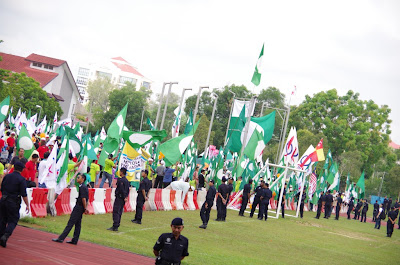
So, first thing I did was wake up at an ungodly hour on nomination day, to travel to the nomination centre for P102 – Serdang. The nomination centre was at the MPKJ Stadium. I was going there to support the candidate who was running there. I was also interested to take part in the atmosphere.

I arrived pretty early – before the crowd arrived. I easily got a parking nearby and proceeded to the stadium. There were small pockets of people milling about and the police were busy executing drills in the stadium compound. Otherwise, everything was real quiet.

Then, the supporters started to arrive. The BN supporters basically invaded the two mamak stalls serving breakfast in the area. Everyone was busy getting a bite before the activity ahead. I’m sure that everyone woke up at ungodly hours too.

The stadium had been nicely divided into two sides. Supporters from each side were encouraged to gather on the appropriate side of the stadium. So, I made my way to the south side of the stadium to gather with some other friends who were already there.

I got there just in time to catch the main procession of supporters coming it. There were huge numbers from PAS who came. I attribute this to the fact that the stadium was located near Bangi, a traditional PAS dominant area. Then, came the DAP procession with my friend in tow.

The atmosphere on the PR side of things was a rather interesting one. For the first time ever, I saw clear signs that both DAP and PAS supporters were truly supportive of each other. Everyone knew about the potential plight that DAP candidates may be forced to run under the moon symbol. So, everyone was supportive.

In fact, things have certainly changed. I saw old Chinese men and women carrying the PAS flag and even cloaking themselves in the flag. This would have been unimaginable, a mere 10 years ago. PAS’s Islamist image has been its bane and a source of tension with the non-Muslim community in Malaysia in the past.

However, things have certainly changed today.

Things continued to stay very calm through most of the nomination period. Supporters from both sides kept to themselves and ran their own little activities. Things only got really boisterous when the candidates were announced and when it was known that DAP would be allowed to run under the rocket symbol.

The unforgiving sun was beginning to get the better of me. I stayed on until all the candidates names were announced. Then, I bade my friends farewell and went off.

KPOP Gavy NJ

The girls may not be as hyper as some other Kpop groups, but they can certainly sing!

One Too Many Computer Science Programmes?

This article first appeared on Digital News Asia here.

I started writing this article, wondering if there were one too many Computer Science (CS) degree programmes in Malaysia. My gut feel was that there were definitely too many CS programmes in Malaysia but I needed to get my facts straight first.

Looking up the institutions listed in the latest MQA Rating System for Higher Education Institutions in Malaysia for 2011 (SETARA’11) ratings, I found that the vast majority had actual CS degree programmes advertised on their websites while others had CS-related ones (e.g. Computing, Computer Engineering, etc) with the exception of a few specialist universities such as medical and teaching ones.

So, it is safe to say that almost every university and university college in Malaysia has one. This does not surprise me as CS is a relatively cheaper course to run, with less capital expenditure needed for physical infrastructure, unlike some other engineering or science programmes that need expensive lab facilities.

While there is certainly no lack of choice for anyone interested in earning a CS/CS-related degree in Malaysia, I asked myself whether these programmes were meeting market demand. If there were too many CS programmes, one would imagine that there would be a large number of unemployed CS graduates as supply exceeds demand.

Based on the results of the Graduates Tracer Study for 2011 released by the Ministry of Higher Education (MOHE), ICT graduates were no more employable nor unemployable than their peers from other fields. Out of every four ICT graduates, one remained unemployed after graduation while two others were fully employed within a 3-4 month period.

According to the ICT Job Market Outlook report released by the National ICT Association of Malaysia (PIKOM) in 2012, the future for ICT graduates seems exceedingly bright. The average salaries for ICT professionals have been steadily rising and that, overall, only the oil & gas sector pays more on average.

One would think that people should be clamouring for places due to the above average pay and the growing job market. Therefore, it did not make any sense that there were still so many who remained unemployed after graduation. Also, according to the same report, ICT job numbers grew at an average of about 27,000 a year over the 2005-2011 period. Something must be amiss.

However, the report also claimed that the quantity of graduates is declining with just under 75,000 enrolments in 2011. With about 27,000 jobs being created each year, there are only enough vacancies to employ less than half of those graduating. Therefore, it is natural that most of those graduating will not be able to find employment in the industry.

Furthermore, the report suggested that not all these graduates end up working in the computing line as there are surely those who end up joining other industries. However, the fact that a full quarter of ICT graduates had difficulty securing employment was a rather alarming figure to me.

While there may not be enough jobs locally, our graduates could surely gain employment elsewhere. In fact, some of these graduates do eventually leave our country for better opportunities elsewhere and the ones who leave are also inadvertently more fluent in English, as is highlighted by the report.

The said report also highlighted that the quality of graduates is declining, and the MSC Malaysia Talent Supply-Demand Study 2010 – 2013 said that less than 30% of employers believe that their fresh hires are of good quality. While our job market may be growing, our graduates are less capable of meeting the requirements of the job. As a result, they are fast becoming unemployable.

From both the studies and the report, I have to say that we have an acute problem. While it is not difficult to hire people, it is very difficult to hire good people, which is corroborated with the situation on the ground. What the entire industry sorely needs is brains, but what we get are mostly bodies. For some reason, our universities are not graduating the right kind of people.

I have to also point out that it is not the duty of a university to produce job-ready products for the market but to nurture critical thinkers and creative doers. Unfortunately, the same report mentions that our graduates are lacking such traits amongst other things, and recommends that our government review the entire education system.

Therefore, the real problem is that we have one too many bad CS programmes in our country.

Naturally, after confirming that a problem exists, the next question that I’d ask myself is this: whose fault is it anyway? In my next column, I intend to look at where the faults lie – systemic flaws, teachers’ failures, student apathy, and the role of parents and industry in all of this.

Parliament Dissolved

Finally, after an extremely long wait, parliament is now dissolved!

This got me to think, as I was driving into work this morning, about how the Pakatan Rakyat state governments should have dissolved the state assemblies on 8/March. By not doing so, they essentially lost the moral right to criticise the federal government for over-staying.

This is because the rakyat gave both the federal and state governments, a five-year mandate to govern, from 8/March/2008. Therefore, all the state governments and federal one have been governing without a mandate for the last month or so.

If the Pakatan Rakyat state governments had dissolved their state assemblies earlier, as was initially hinted by the Selangor Menteri Besar, they would have managed to 1-up the federal government by sticking to the principles and not over-staying their mandates.

Furthermore, if they had dissolved their state assemblies earlier, they would have forced the federal government’s hands by essentially shifting the deadline to hold state elections to an earlier date.

But all that’s said and done, I hope that we can get this over and done with as soon as possible. I do hope that the Elections Commission sets an early date for the General Elections and to not wait till May to run it.

Good luck to everyone who will be running!